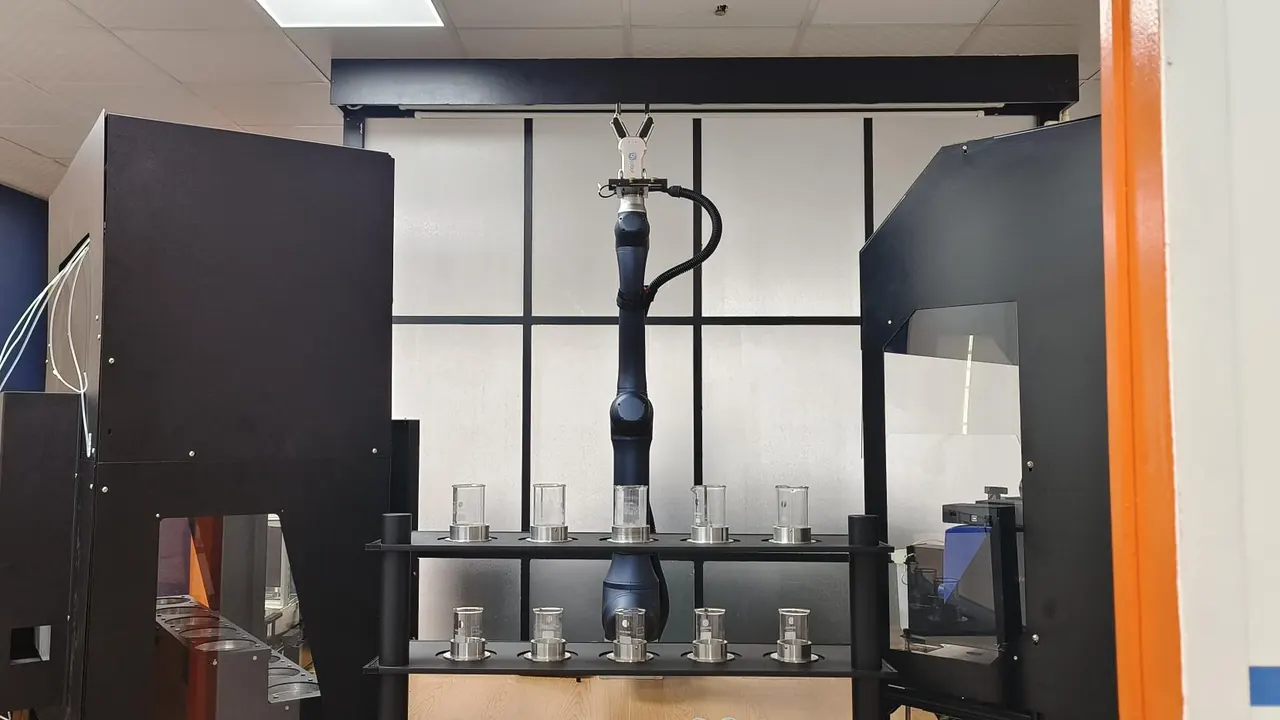
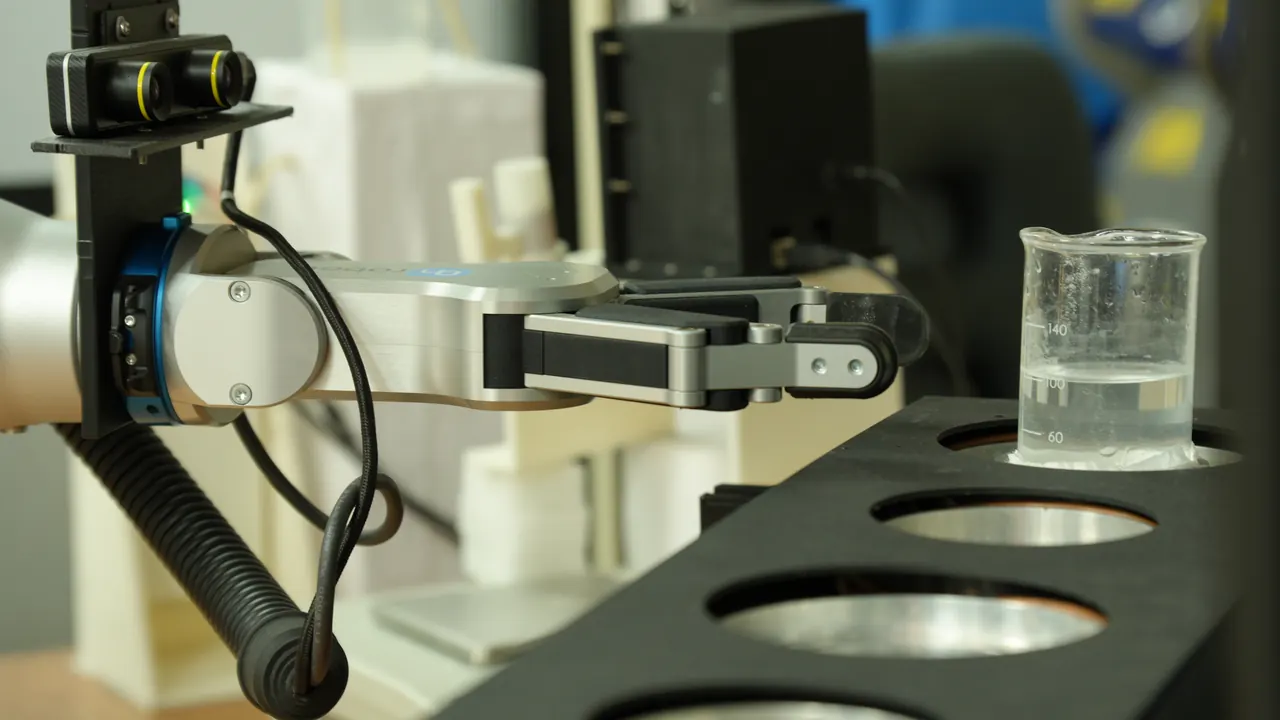
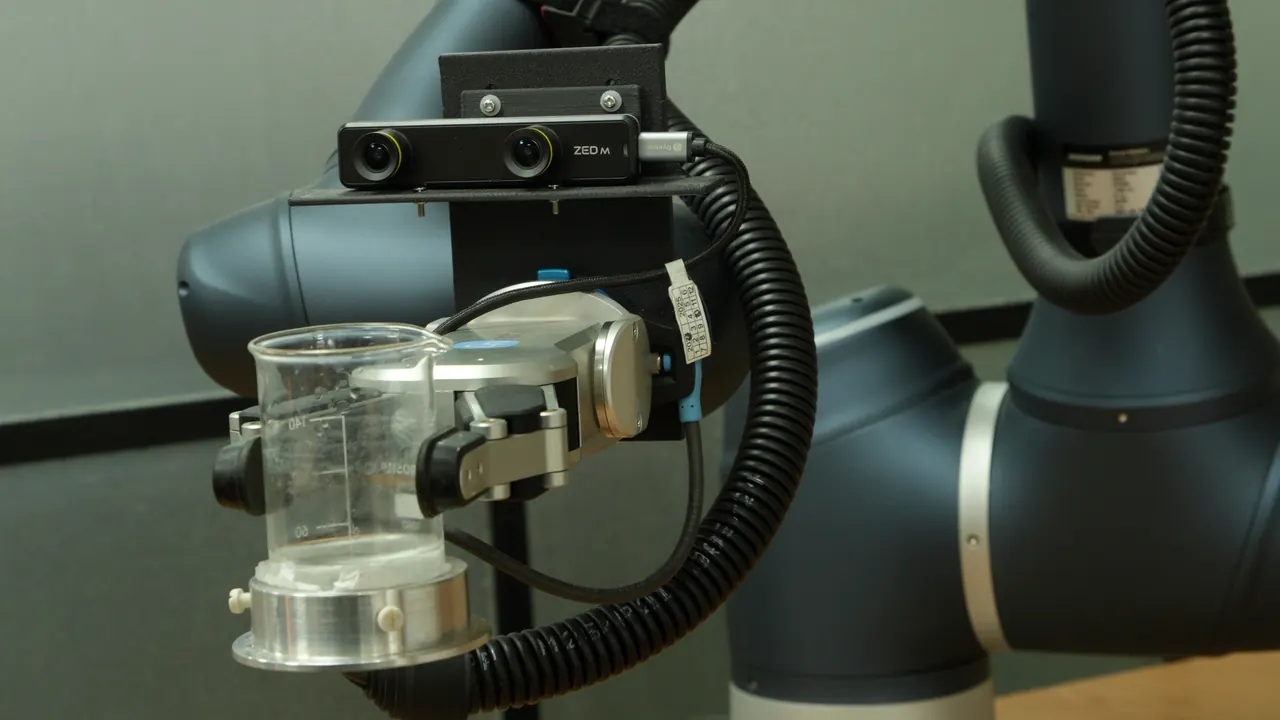
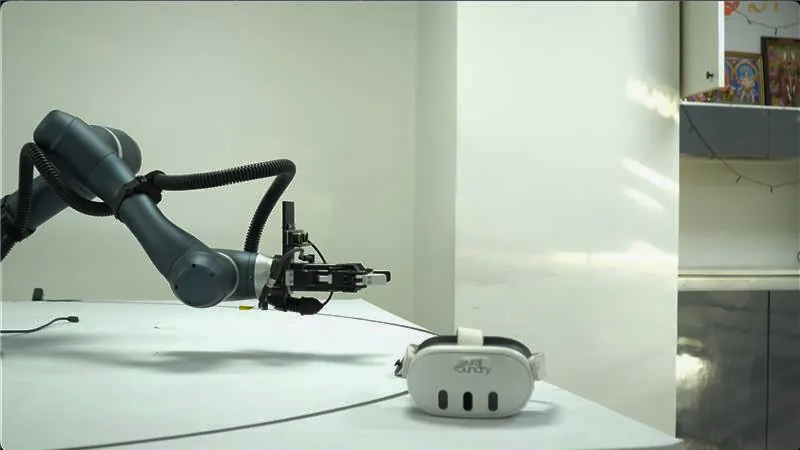
2020 The same desk, earlier: one chair, one screen, a blank board, and more ideas than things.
now A second chair, a team on the board, a full shelf, and a robot getting on with its work. Curious about everything. I learned I can’t build it alone.
Gears I trained as a mechanical engineer, and moved into software to make machines move.
A circuit board Embedded C is still part of the work: each lab device, from its own code up to the controller.
Pull up a chair. This is what we have been building.
starting the simulation
What the robot in the room sees, live: the amber box is the robot, red is its lidar, green is the way it means to go, blue is its dock.
01 Now
This is what I work on today.A robot arm on its own does very little. The work is getting ten different machines to act as one.
I was the first engineer on ALEX, the system that runs lab tasks with a robot arm. I wrote most of the first version; the team that joined took it to its first stable release with me.Neural Foundry · 2024–26
We brought around ten lab devices under robot control in a client’s lab: dispensers, balances, a pipette station, a homogenizer, pumps. Each one from embedded code up to the controller.Neural Foundry · 2025–26
I designed the two clients that connect any robot or device to URP, the company’s robotics platform. One config-driven command server now handles arms, mobile robots and cameras.Neural Foundry · 2026
We made device health visible: logs as telemetry, online and offline state, authenticated messaging.Neural Foundry · 2026
We moved the system to ROS 2 Jazzy and built a simulated twin of the cell, where the same automation runs before it touches hardware.Neural Foundry · 2026
Made possible by the robotics team at Neural Foundry, the platform, AI and XR teams we build with, and the company that backed the work.
The day the pH meter joined
5 September 2024, with a demo coming. The arm could already move and pour. That day we brought the pH meter into the cell.
We tested the measurement on its own first, with the arm held still, then joined the two. The first commit went in at 11:28 and the twenty-first at 22:37. A little after eight in the evening, the robot read a pH value for the first time.
Moving the arm is the easy part.Making it safe, repeatable, and able to carry on after something goes wrong is the job.
I built a multi-layer graph of safe points, searched with Dijkstra’s algorithm, so the arm always travels through known-safe positions.Neural Foundry · 2025
We made the arm recover from faults: runtime errors, a lost controller connection, resuming a task partway through.Neural Foundry · 2025
Small fixes merged upstream in MoveIt 2 and in Doosan’s official ROS 2 driver.Open source · 2025–26
For client projects I evaluate and select robots: collaborative arms, a SCARA, mobile robots from four vendors.Neural Foundry · 2026
Made possible by the open-source ROS 2 and MoveIt communities, and teammates who collected safety points and tested on the real station.
Only through known-safe points
The arm does not plan a path through open space. It travels through a graph of positions that are known to be safe, arranged in layers.
Teammates collected those points and tested them on the real station. My part was the graph and the search: Dijkstra’s algorithm picks the route.
When something does go wrong (a runtime error, a lost connection to the controller) the task can resume partway, not from the start.
Where I started, and where I spent four years:robots that find their own way around places where people live and work.
I inherited a ROS 1 navigation stack. With my team I rebuilt it and moved it to ROS 2, including path-tracking controllers I wrote (pure pursuit and Stanley).Invento (Mitra) · 2020–22
The robot went on to run 1,000 km autonomously without an incident, as the company announced.Invento (Mitra) · 2023
I wrote autonomous docking using visual markers, so a robot could find and reach its charger alone, and trained teammates and customers to use it.Invento (Mitra) · 2020–22
We added fleet patrol, and mapped and deployed robots at customer sites. One of them I mapped without being there, by driving the robot remotely from another country.Invento (Mitra) · 2023–24
On the fleet web apps I worked on the takeover page (driving by gamepad and keyboard, chat, robot controls) and, in the later care portal, most of the live map after our founder started it.Invento (Mitra) · 2022–24
At Neural Foundry I designed the mobile-robot side of our ROS 2 client, and my team rebuilt mapping, navigation and docking in simulation.Neural Foundry · 2026
Made possible by the Invento (Mitra) team, the people who built the stack I inherited, and Nav2.
From a hand-me-down stack to 1,000 km
The navigation stack came to me second-hand, written for ROS 1. ROS 1 was on its way out, so we had to move anyway.
With the team I rebuilt it on ROS 2 and Nav2. With the standard controller the robot wobbled and cut corners, so I wrote our own to keep it on its path.
Five or six robots moving at onceThrough a narrow passageA person steps into its path
Teaching a robot to dock itself
A robot that cannot reach its charger alone needs a person every few hours.
We looked at three ways to find the dock: a known spot on the map, its shape in the lidar scan, and printed markers the camera can see. We settled on the markers.
The hard part was the last few centimetres: lining up and backing on until the contacts touch. Then I taught teammates and customers how to set it up.
Docking, seen from the side
Mapping a building without being there
To map a building, someone usually walks the robot around it. This time the robot was in another country and none of us were.
Over the years before, without planning for this, we had built the pieces: a way to reach a robot inside a site’s network, a way to drive it from afar, and a map that draws itself in the browser.
Late at night in India, because of the time difference, I drove it with those and a remote desktop, and watched the map fill in. No one was on site: the building was step-free, so the robot went everywhere on its own.
04 Remote hands
I keep coming back to this:a person in one place, a robot in another, and as little delay between them as possible.
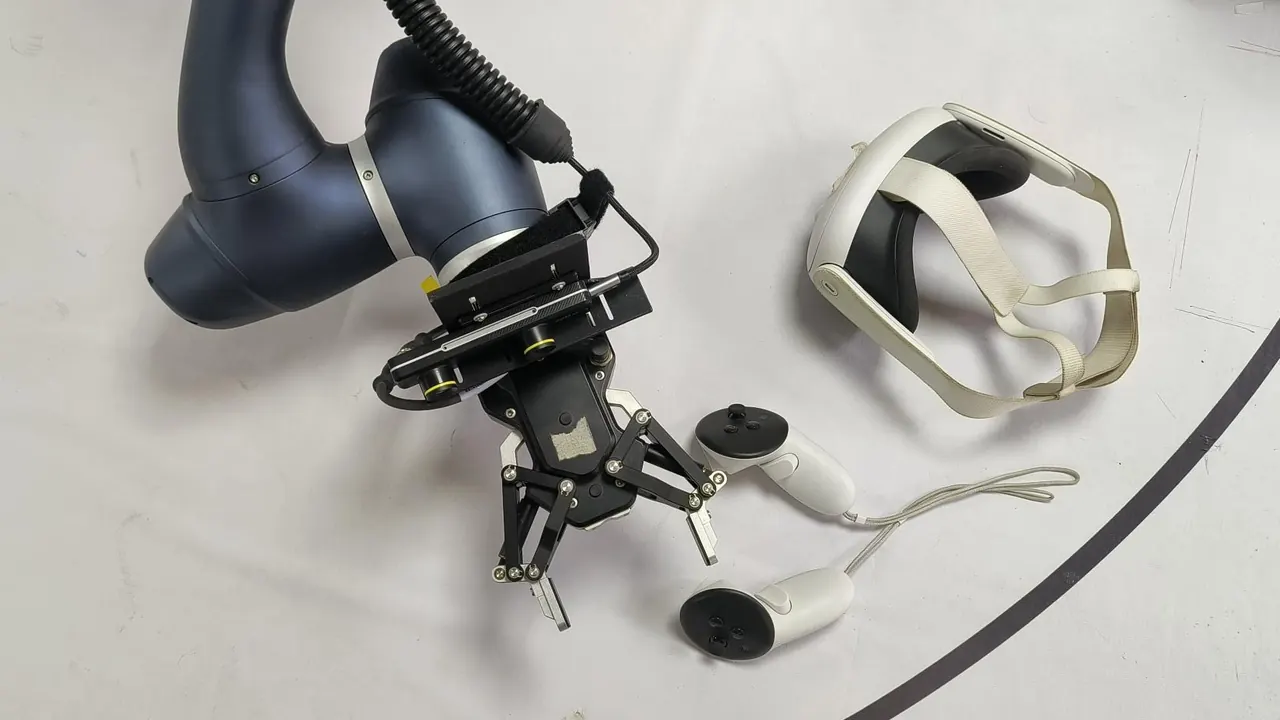
I designed the peer-to-peer link behind RAVEN, the company’s VR teleoperation. We tested it from Europe to India over an ordinary home connection, at about 100 ms.Neural Foundry · 2024–
I built joystick teleoperation for the fleet. The controller vibrates when the robot nears an obstacle, so the operator feels it.Invento (Mitra) · 2022–23
I built the WebSocket layer between robots and the care portal, tested to over 1,000 connections at once.Invento (Mitra) · 2023–24
I moved our robot camera streaming to WHIP and a media server. The robot used to keep a connection, and its own encoding, for every browser watching; now it sends one stream, which serves every viewer and can be recorded and monitored as it runs. With stereo camera support.Neural Foundry · 2026
Made possible by the XR team who built RAVEN’s virtual side, and the platform team who run the streaming servers.
Picking up a pen from another continent
The test was small on purpose: pick up a marker pen, lay it down flat. A pen, because it shows straight away whether the grip and the release are right.
We first ran it from a home connection in Europe, with the arm in India. Then, at an expo in Europe, our CEO, our CTO and visitors took turns in the headset.
A robot is only as useful as what it knows about the world in front of it.
I worked with the chief architect on the image and video pipelines behind Mitra AI, which let you search and question camera footage in plain language.Invento (Mitra) · 2023–24
We use visual markers so the arm can find equipment and containers without being told exact positions.Neural Foundry · 2025–26
Next: a vision-based quality inspection showcase, planned for 2027.Neural Foundry
Made possible by the chief architect and AI team at Invento, and the AI team at Neural Foundry.
06 Robots for people
For four years the robots I worked on had one job:keeping older people company and getting them through the day.
We built the daily flow: a sequence of news, music and exercise, where the order is set but the content is chosen from each person’s history and preferences.Invento (Mitra) · 2023
I built the recording tools for a public gesture dataset: 35 gestures from 39 people, 22 of them over 70.Invento (Mitra) · 2023–24
I built tools for a machine learning course: bots that answered students’ questions and ran quizzes.Invento (Mitra) · 2023–24
Made possible by the whole Invento (Mitra) team, and the seniors who took part.
Following someone across a room
A team project. The robot tracks a person’s body and face, follows them, and stops when they sit down.
The daily flow ran on the robot’s screen: some news, some music, a little exercise, one after the other.
Crossing the office to a seated personFollowing a person until they sitThe daily flow on the robot’s screen
07 Humanoids
I have built one arm of one, from the firmware up.I have not worked on a whole one yet. It would be cool to.
I prototyped the control system for a humanoid robot’s arm and hands: motor control, communication between boards, power measurement.Invento (Mitra) · 2020–22
We built the robot hardware that a research lab then used for brain-computer-interface work. The brain interface was theirs.Invento (Mitra)
Made possible by the hardware team at Invento (Mitra).
One arm, from the firmware up
A prototype. The hardware team built the printed parts, motors and boards and handed them to me; I worked from the firmware up: Arduino boards talking to each other, and the control on top. It raised an arm and flexed a hand.
The parts held up well. What broke, now and then, was a tension string in the hand.
The rest is not about robots. It is in the notebook on the desk.
who is on what
Bugs
B2 Arm stops for good after a lost connection
Features
Built by the team. I set each task and reviewed it.
F4 Pick and place with an arm on wheels
B1On the office network the robot’s video was instant. On a phone hotspot it would not connect at all.Some mobile carriers block UDP, so the two ends could not reach each other directly.The fix was a relay (TURN) for the cases where a direct path is not possible.
F1Device logs as telemetry
The critical logs on each edge device are exposed live, so a problem can be debugged while it is happening, without anyone walking over to the device.
F2The lab cell, simulated then real
A copy of the lab cell in Isaac Sim. Every automation runs there first, then the same flow runs on the real robot.
Why
New flows are tried without risking glassware or real devices. The simulated devices talk to the platform exactly like the real ones.
My part
I look after the project and have reviewed 65 of its pull requests.
Built with
Isaac Sim, ROS 2 Jazzy
F3Mapping and docking in simulation
A mobile robot maps a simulated warehouse, finds its way around it and docks to charge.
Why
It docks to a printed marker and runs on Nav2, the approach I built on a real robot at Invento in 2020–22. Six years apart: real then, simulated now.
Built with
Nav2, Isaac Sim, Gazebo
Mobile robots
On now
F4 Pick and place with an arm on wheels
engineerMobile robots
On now
engineerMobile robots
On now
Manipulators
On now
B2 Arm stops for good after a lost connection
engineerManipulators
On now
Simulation
On now
me
For the first ten months, most of the code in ALEX was mine, pushed straight in, most often around eight in the evening. There was hardly anyone to read it.
In spring 2025 the team began to arrive, and that way of working had to end: every change now goes through review. By the autumn the team was writing more of ALEX than I was, and most of my week had become reading their work. The hardest part was handing over the interesting work and keeping the planning.
set up Ubuntu
learn ROS
what is SLAM?
ClickTap a bug, a feature or anyone on the tree to read more.
The WebRTC evening
A teammate was building our WebRTC streaming and it was not working yet. I had worked on it before, so I got curious and sat down with him.
We spent that evening on how WebRTC works underneath. Once he knew what I knew, we went looking for the real cause together: the browser’s WebRTC internals, STUN, starting with Google’s server.
He built the first connection, from a Python sample I had given him. On the office network it was instant.
Then we tried a phone hotspot and it would not connect. Some mobile carriers block UDP. That took us to TURN.
More evenings to come.
None of this was mine alone.
The Invento (Mitra) team, and the people who built the stack I inherited there.
The robotics team at Neural Foundry.
The AI, XR and platform teams we build with.
The open-source projects underneath all of it: ROS 2, Nav2, MoveIt.